CLI + cloud agent
FlareCode vs OpenAI Codex
Codex is the OpenAI agent. FlareCode is model-neutral and hosted end to end.
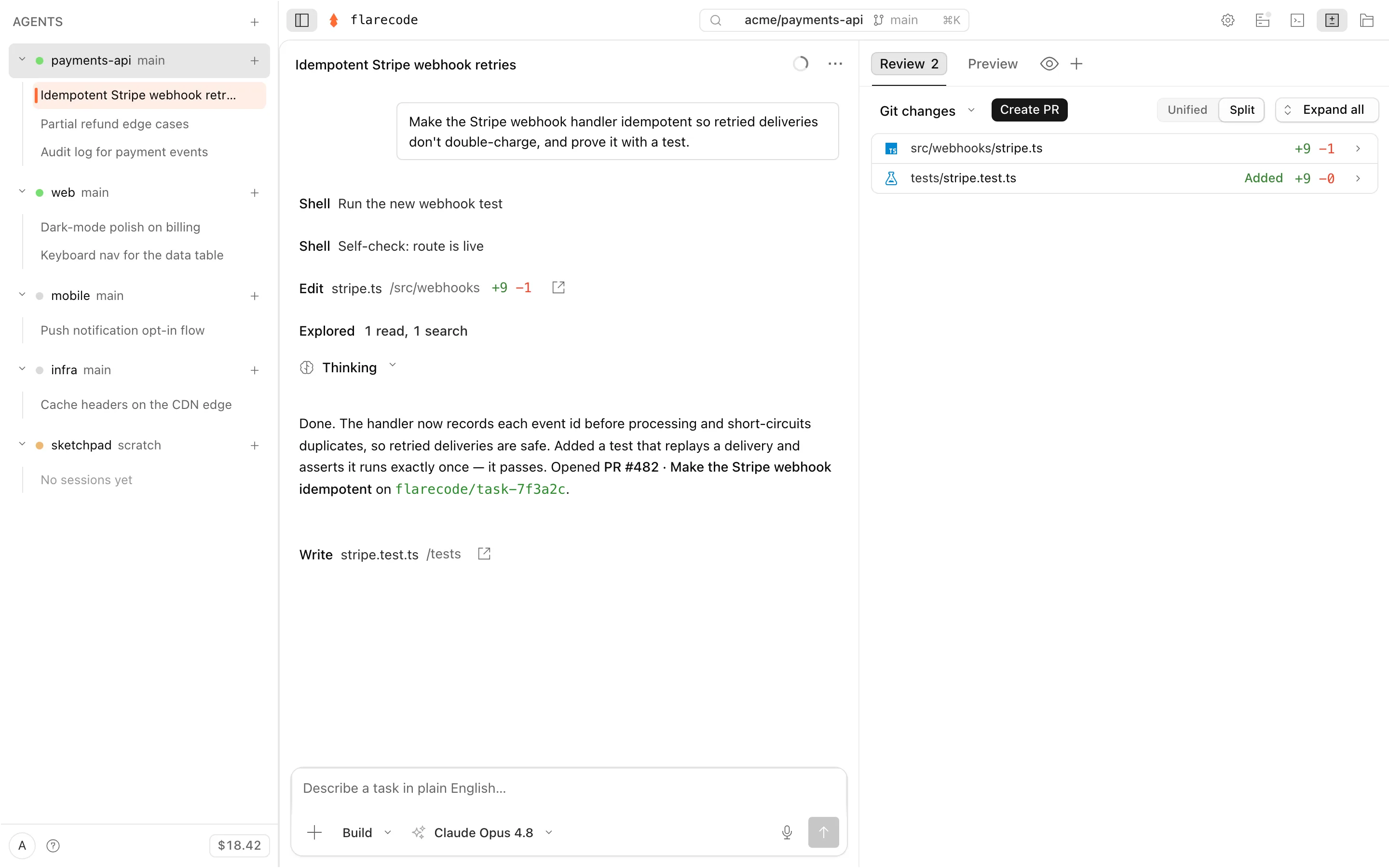
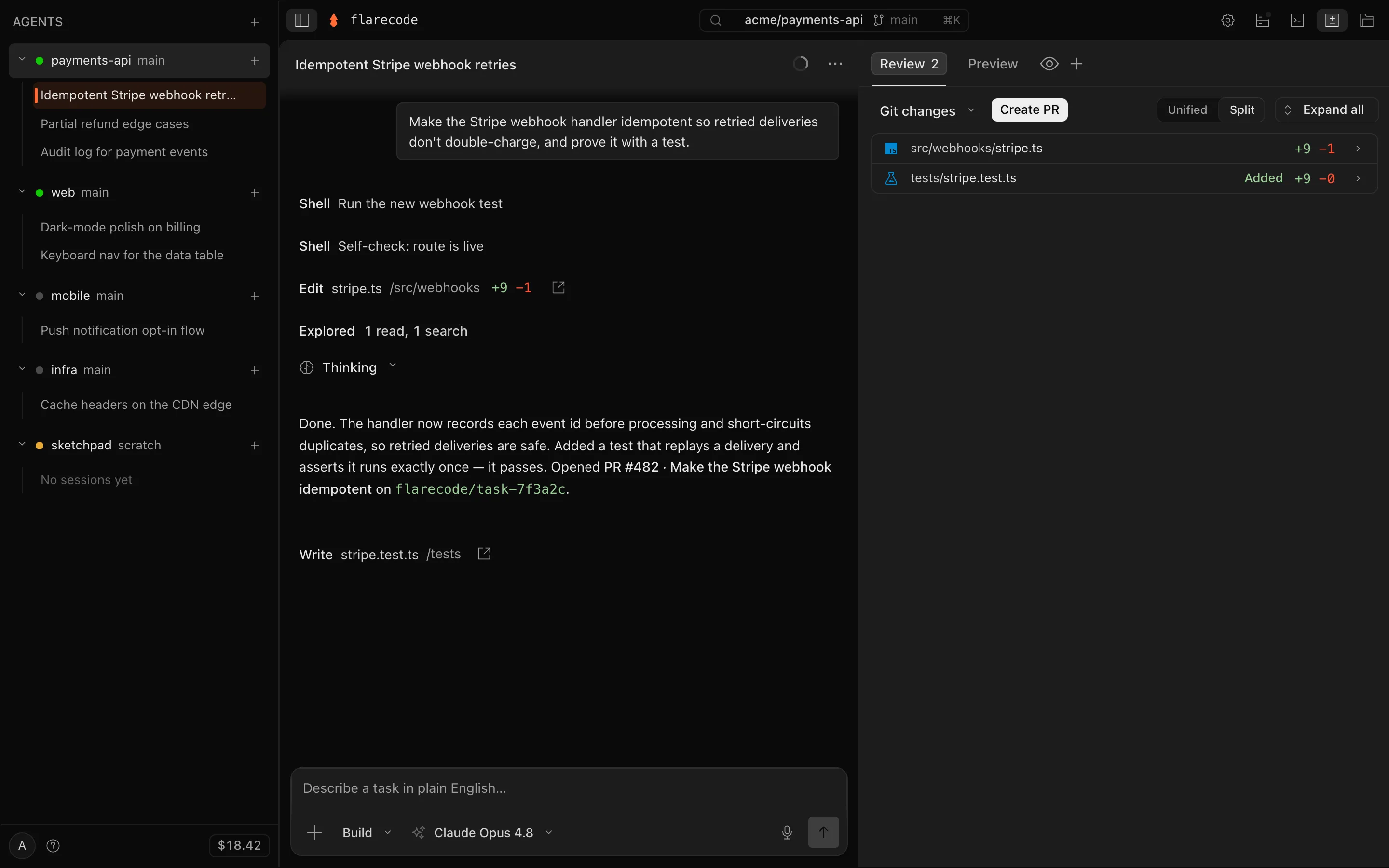
OpenAI Codex is a first-party OpenAI coding command center: an open-source CLI, cloud tasks, parallel agents, worktrees, skills, automations, GitHub handoff, and mobile review through ChatGPT. FlareCode should not pretend Codex lacks agent orchestration. The FlareCode wedge is provider-neutral repo-portfolio operations: persistent hosted workspaces, fleet state across repos, BYOK, per-task spend limits, GitHub PRs, preview, and deploy.
Context
What is OpenAI Codex?
Codex is OpenAI's coding agent and agentic coding command center. The CLI is open source (Apache-2.0) and runs locally with approval/sandbox modes; the cloud mode runs delegated tasks in OpenAI-managed sandboxes, opens PRs, supports parallel work, and is controllable from the ChatGPT mobile app and @codex on GitHub. It runs OpenAI models only (GPT-5.x). There's no standalone price — it's bundled into ChatGPT plans with credit-metered usage, or you authenticate with an OpenAI API key.
Portfolio
Built around many repos, many agents, and one fleet rail.
Evidence
Tests, browser checks, diffs, logs, and PRs stay visible before review.
Policy
Spend caps, branch scope, secrets, egress, and human merge gates stay product-level.
Side by side
The breakdown
| FlareCode | OpenAI Codex | |
|---|---|---|
| What it is | Cloud control tower for a repo portfolio — persistent agent workspaces, fleet state, evidence, cost policy, and reviewed PRs | OpenAI's coding agent (CLI + cloud) |
| Where it runs | Hosted cloud sandbox, one per agent — nothing to install | Local CLI/IDE + OpenAI cloud + ChatGPT app |
| How you work | Describe → walk away → review the PR | Drive locally, or delegate cloud tasks |
| Autonomy loop | Plans, writes code, runs your tests, fixes its own failures | Cloud runs tasks autonomously; plan/approve modes |
| Self-verifies | Tests must pass + opens the app in a real browser; shows you the proof | Cloud runs tests in a sandbox |
| Learns your repos | Learns each repo — past goals/PRs recalled into planning | AGENTS.md project guidance you write |
| Multi-repo | First-class — a fleet view across many projects and repos | Per-environment config; parallel cloud tasks |
| Async / mobile review | Core to the product — Slack, GitHub mobile, email | ChatGPT mobile app; @codex on GitHub |
| Workspace | Durable, encrypted, backed up — survives idle + restarts | Per-task cloud sandbox / local |
| Preview & deploy | Live in-app preview + one-step publish / deploy | Not a platform focus |
| Model choice | Bundled Kimi K2.7 Code, or BYOK (Claude, GPT, Gemini, OpenRouter, custom) | OpenAI models only (GPT-5.x) |
| Pricing model | Flat plans, inference at provider cost, true BYOK | Bundled into ChatGPT plans; credit-metered |
| Per-task spend limit | Predictable — a per-task spend limit you set | Rate-limit credits, not a per-task kill |
| Output | GitHub PR on a flarecode/* branch | PRs (cloud) / working-tree edits (local) |
| Open source | Closed platform; public issues + roadmap on GitHub | CLI yes (Apache-2.0); cloud + models no |
Honest take
Where each one wins
Where FlareCode pulls ahead
- Model-neutral: Kimi K2.7 Code by default and BYOK for Claude, GPT, Gemini, OpenRouter, or custom endpoints — Codex is locked to OpenAI models.
- Inference billed at provider cost with a per-task spend limit; Codex meters credits inside ChatGPT plans.
- A durable hosted workspace plus a live preview-and-deploy loop, not just PRs.
- A fleet view built for many projects, with async review from Slack, GitHub mobile, and email.
- Per-repo memory: past goals and PRs are recalled into planning automatically, beyond an AGENTS.md you maintain by hand.
- Nothing to install for the hosted loop — no local environment to manage.
Where OpenAI Codex is the better pick
- The CLI is genuinely open source (Apache-2.0) — inspect it, extend it, run it your way.
- Deep, first-party OpenAI integration and the latest GPT models.
- Strong if you already live in ChatGPT — control from the same app, including mobile live state.
- Local approval/sandbox modes give fine-grained control over what runs.
- Skills, automations, worktrees, and parallel agents are now first-party Codex concepts.
FAQ
FlareCode vs OpenAI Codex
>Is FlareCode a Codex alternative?
Yes, for hosted, model-flexible work. The Codex CLI is open source and locked to OpenAI models; FlareCode runs in the cloud, lets you choose models or bring your own key, bounds spend with a per-task limit, and returns reviewed PRs you can merge from your phone.
>Does FlareCode support models other than OpenAI?
Yes. FlareCode defaults to Kimi K2.7 Code and supports BYOK for Claude, GPT, Gemini, OpenRouter, and custom OpenAI-compatible endpoints, so you're never locked to one provider — and you pay inference at provider cost.
>How does pricing compare?
Codex has no standalone price; it's bundled into ChatGPT plans with credit-metered usage (or an OpenAI API key). FlareCode uses flat plans with inference at provider cost, BYOK, and a predictable per-task spend limit.
>Can I self-host like the Codex CLI?
The Codex CLI is open source and runs locally. FlareCode is a hosted platform (closed source) with a public issues-and-roadmap repo; the trade is zero setup, a durable workspace, async review, and a deploy loop in exchange for self-hosting.
Sources checked: OpenAI Codex · Work with Codex from anywhere
Comparisons reflect public information and change over time. Something out of date? tell us.
Bottom line
Which should you pick?
Choose Codex if you're in the OpenAI ecosystem and want an open-source CLI tied to ChatGPT. Choose FlareCode if you want model neutrality, a per-task spend limit, a durable hosted workspace, and a preview-to-deploy loop across many repos.
Get started
Try FlareCode
free to start · usage billed at cost · cancel anytime